

You and your partner may still love each other and have no intention of separating. Yet certain conversations keep turning into arguments, or you may feel that the emotional connection you once shared has changed. These difficulties might not make you question your future together, but they can still affect how you experience your marriage. You may even wonder whether they are serious enough to deserve professional attention.
Many people associate marriage therapy with couples whose relationships are close to breaking down. However, professional support can also be helpful when both partners want to stay together but recognise that certain aspects of their relationship could improve. Understanding what therapy can offer outside a crisis may help you decide whether it is worth considering for your marriage.

Why Is Marriage Therapy Seen Only as a Last Resort?
Marriage therapy is often seen as a last resort because people associate it with serious relationship problems, such as infidelity or persistent conflict. This perception is reinforced by media portrayals of couples seeking counselling when their marriages are close to ending. As a result, couples who are generally happy together may assume that professional support is unnecessary or that seeking it means admitting their relationship is failing.
This belief can also be influenced by personal expectations about marriage. Some people grow up believing that couples should be able to resolve their disagreements independently. When a relationship is generally stable, seeking outside support may therefore seem excessive, particularly if both partners remain committed to staying together.
However, commitment and relationship satisfaction are not always the same thing. Couples may share a strong sense of loyalty while struggling to communicate about certain subjects. They may enjoy their life together but find that emotional closeness has gradually become harder to maintain. These experiences do not necessarily mean the marriage is in trouble, but they can still affect how both partners feel within the relationship.

What Happens in Marriage Therapy When Things Are Stable?
When a marriage is generally stable, therapy may focus on improving communication, understanding recurring disagreements and strengthening emotional connection. Rather than discussing whether the relationship should continue, couples can work with a counsellor to explore what they would like to change. Sessions provide a structured environment where both partners can express their perspectives and develop a clearer understanding of how they relate to each other.
For couples who are not considering separation, the first counselling sessions may involve discussing what brought them to therapy and identifying what they hope to achieve. One partner might want to communicate more openly, while the other may feel that certain disagreements are never fully resolved. A counsellor can help both partners explore these concerns without turning the conversation into an argument about who is responsible.
For example, imagine a couple who regularly disagree about spending time together. One partner may feel that work and other responsibilities have taken priority over the marriage. The other may feel frustrated because they believe their efforts to support the household are being overlooked. When they discuss the issue at home, the conversation might quickly become defensive, with one partner complaining about the lack of quality time while the other points out everything they already do.
Although the disagreement appears to concern time, the underlying feelings may be more complicated. One person may be seeking reassurance that the relationship remains important, while the other wants their contributions to be recognised. Therapy can help couples explore these different perspectives and understand why their conversations repeatedly reach the same point.
This is an important distinction because resolving an individual disagreement may provide temporary relief, but understanding the pattern behind it can help partners approach similar situations differently in the future. Instead of focusing solely on who is right, couples can begin exploring what each person needs and how those needs are being communicated.
Beyond recurring disagreements, sessions may also provide opportunities to discuss subjects that rarely receive much attention during everyday life. Couples can become so occupied with work, family responsibilities and practical decisions that conversations about emotional needs or changing expectations gradually become less frequent. A counsellor may encourage partners to reflect on how their relationship has evolved and whether their current ways of communicating still meet their needs.
Exploring these concerns can help couples identify changes they would like to make, although progress depends on both partners’ willingness to participate. Developing new ways of communicating also takes time and practice.

Can Early Marriage Therapy Keep Small Problems from Growing?
Early marriage therapy may help couples address recurring misunderstandings before they develop into more established patterns of conflict or emotional distance. When frustrations remain unresolved, partners can gradually become accustomed to reacting defensively or avoiding difficult conversations. Therapy provides an opportunity to recognise these patterns and explore more constructive responses, although it cannot guarantee that future relationship problems will be prevented.
To understand why addressing concerns early may be helpful, consider how ordinary disagreements develop over time. Differences in habits, expectations and priorities can occasionally create tension, even between partners who generally communicate well. Most of these disagreements are manageable, but difficulties can arise when similar frustrations continue without meaningful resolution.
For example, a couple may frequently disagree about household responsibilities. One partner might feel that they carry most of the mental load of organising family life, while the other believes they are contributing fairly. Initially, these disagreements may seem relatively minor. However, if neither partner feels understood, frustration can begin influencing how they interpret each other’s behaviour.
A forgotten task might gradually be seen as evidence of a lack of consideration rather than an ordinary oversight. Meanwhile, a reminder about that task might be interpreted as criticism rather than a request for help. Over time, both partners may become increasingly defensive, even when neither intends to create conflict.
This illustrates how recurring disagreements can become connected to broader feelings of being unsupported or unappreciated. As these feelings develop, couples may find themselves reacting to previous frustrations rather than responding only to the situation in front of them.
Another pattern involves avoiding difficult conversations altogether. A couple may decide not to discuss certain subjects because previous attempts have ended in arguments. Although this can reduce immediate tension, the underlying concerns may remain unresolved. Eventually, one or both partners may feel that important parts of their experience are no longer being acknowledged.
Seeking support earlier may help couples identify these patterns while they are still willing to discuss them constructively. A counsellor can help partners recognise how their reactions influence each other and explore alternative ways of expressing concerns.
For instance, instead of responding to a disagreement by listing previous mistakes, a partner might learn to explain what they are feeling and why the issue matters to them. This may give the other person a better opportunity to understand the concern without immediately becoming defensive.
These changes require practice and may not happen quickly. However, recognising recurring patterns earlier may help couples respond differently before those patterns become more established.
When Should You Consider Marriage Therapy?
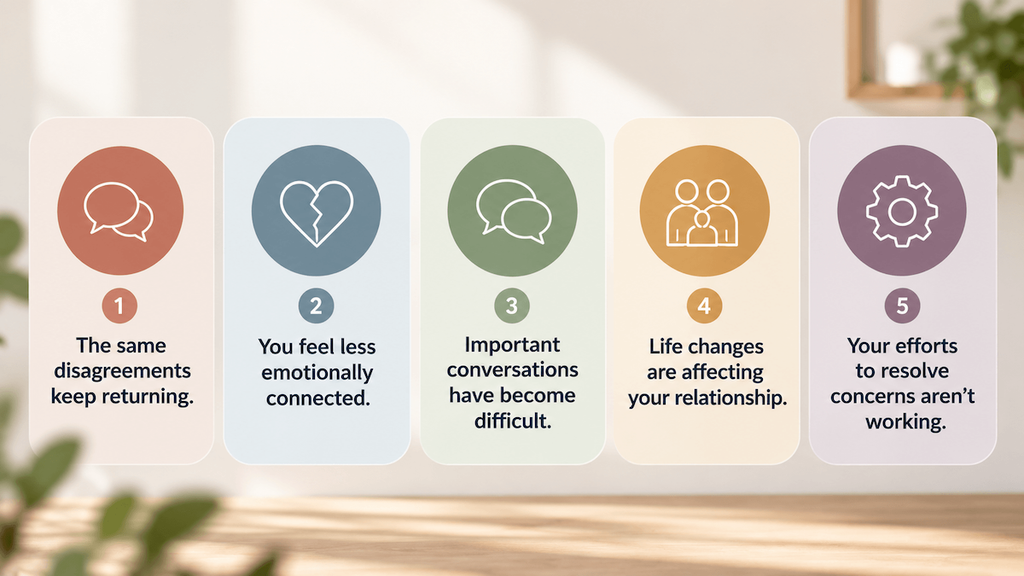
There is no universal point at which couples should seek marriage therapy. Professional support may be worth considering when recurring disagreements remain unresolved, emotional closeness has changed or important conversations have become difficult. Therapy can also be helpful during significant life transitions, particularly when changing responsibilities or expectations affect how partners relate to each other.
One reason couples hesitate is that their difficulties may not seem serious enough. They might still enjoy spending time together and feel confident about their future, making the idea of attending therapy seem unnecessary. However, the decision does not have to depend on whether the marriage is in crisis. A more useful starting point is to consider whether certain concerns keep returning despite genuine efforts to address them.
For example, you and your partner may repeatedly promise to communicate more calmly during disagreements. Yet when a sensitive subject arises, you find yourselves responding in the same familiar ways. You may understand that the pattern is unhelpful but struggle to change it. In this situation, professional guidance could provide a different perspective and help you explore why previous attempts have not led to lasting improvements.
Changes in life circumstances can also affect a marriage, even when the relationship was previously functioning well. Becoming parents, for instance, can introduce new responsibilities and reduce the time couples spend together. Partners may have different expectations about household responsibilities or personal time, creating tension if these differences are not discussed openly.
Career changes can have a similar effect. A new job or period of financial uncertainty may alter how couples share responsibilities and spend time together. Other transitions, such as moving home or caring for ageing relatives, can also require adjustments that neither partner anticipated.
Although these circumstances do not necessarily indicate relationship problems, they can reveal differences in expectations or communication styles. When couples struggle to navigate these changes together, therapy may offer an opportunity to discuss their concerns in a more structured environment.
Another reason to consider therapy is a gradual change in emotional connection. You may find that conversations increasingly revolve around practical matters, such as bills, appointments or family schedules. Although you continue managing life together, opportunities to discuss your feelings or enjoy meaningful time as a couple may have become less frequent.
This does not automatically mean your relationship is deteriorating. However, if one or both partners feel dissatisfied with the change, it may be worth exploring what has contributed to the distance and whether adjustments could help.
A good question is whether you and your partner are making progress when you try to address your concerns together. If you can discuss difficulties openly and make adjustments that work for both of you, professional support may not be necessary. However, if the same concerns continue despite your efforts, speaking with a counsellor may be worth considering.

What If Your Partner Doesn’t Think You Need Therapy?
Partners do not always agree about whether marriage therapy is necessary. One person may feel that recurring disagreements or emotional distance deserve attention, while the other believes the marriage is generally fine. These differences can reflect how each partner experiences the relationship. Discussing the reasons for wanting therapy may help both people understand each other’s concerns before deciding how to proceed.
When neither partner is considering separation, the suggestion of therapy may be particularly unexpected. Your partner might wonder why professional support is necessary when you are both committed to staying together. They may believe that occasional disagreements are simply part of married life or feel that your concerns can be resolved without involving someone else.
Others may interpret the suggestion as criticism, particularly if they believe you are unhappy with their behaviour. For this reason, how you introduce the idea can influence the conversation. Rather than presenting therapy as something your partner needs to fix, explain what you have been experiencing and what you hope could improve.
You might say that you value your marriage but have noticed that certain conversations repeatedly leave you feeling frustrated or misunderstood. You could explain that you would like to find a better way of discussing these concerns together. This approach makes your intentions clearer without assuming that your partner shares your interpretation of the difficulties.
It is equally important to listen to their response. They may feel uncomfortable discussing private matters with a counsellor or be uncertain about what happens during sessions. Giving them space to express these concerns can help you understand their hesitation and avoid turning the suggestion of therapy into another disagreement.
You can also discuss what you both hope to achieve if you attend therapy. For example, you might agree that improving communication would be worthwhile, even if you have different opinions about the seriousness of your current difficulties.
However, couples therapy generally works best when both partners are willing to engage with the process. Pressuring someone into attending may create further resistance and make constructive participation more difficult.
If your partner remains unwilling, individual counselling may provide an opportunity to explore your own concerns and understand how you respond to relationship difficulties. Although individual counselling cannot replace the shared work involved in couples therapy, it may help you gain clarity about your feelings and consider how to approach future conversations.

In conclusion, marriage therapy can be helpful even when neither partner is thinking about separation. Couples may remain committed to each other while experiencing recurring disagreements, communication difficulties or changes in emotional connection. Seeking professional support can provide an opportunity to understand these concerns and explore ways of improving the relationship without waiting for a crisis to develop.
Whether therapy is appropriate depends on your circumstances and what you hope to achieve together. Some difficulties can be resolved through open conversations and mutual adjustments, while others may benefit from professional guidance. Recognising when additional support could be useful allows you to make that decision based on your relationship’s needs rather than the assumption that counselling is only for marriages in trouble.
Would you and your partner like to strengthen your relationship through marriage therapy? Our team of qualified and experienced counsellors offers couples counselling in Dublin to help you work through relationship difficulties. Call 015240708 to discuss how we can support you.